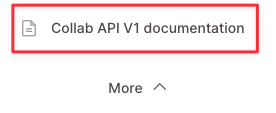
One way to access cohort data is done via a JSON API. Documentation of the various API endpoints is available via the menu at the bottom left of the screen (More > Collab API V1 documentation).
This API follows the JSON:API specification.
Participation dumps
When you only need the data of a single participant, the API can generate a per-participation ZIP dump. Unlike the cohort-wide User data CSV, which exports one CSV per table, a participation dump contains a single intakes.csv (plus the same info.txt metadata file) with one row per intake and a fixed set of already-aggregated columns:
annotation_id: ID of the annotation the intake belongs toconsumed_at_utc: consumption timestamp in UTC (ISO 8601)timezone: timezone of the device at consumption timeconsumed_at_timezone: consumption timestamp in that timezone (ISO 8601)foods: names of the annotation’s foods and products, separated by;energy_kcal: total consumed kcal of the annotation, roundedcarbohydrates_g,sugar_g,fat_g,saturated_fat_g,protein_g,fiber_g,salt_mg: sum of that nutrient over all the annotation’s items, rounded
Nutrient values are computed for the whole annotation, so an annotation with several intakes repeats the same values on each of its rows. If you need the full relational data (all annotation items, all nutrients, comments), use the cohort-wide CSV dump or the JSON endpoints instead.
The workflow uses three endpoints:
| Verb | Path | Purpose |
|---|---|---|
GET |
/collab/api/v1/participations/{participation_id}/participation_dumps |
List dumps already generated |
POST |
/collab/api/v1/participations/{participation_id}/participation_dumps |
Enqueue a new dump |
GET |
/collab/api/v1/participation_dumps/{id} |
Download the dump (302 to the file) |
The POST call returns immediately with a dump in the initial state. A background job then produces the archive; poll the GET show endpoint (or the index endpoint) until the dump is ready. While the dump is not ready, the show endpoint returns a 422 Unprocessable Content with title ParticipationDumpNotReady. Once ready, the show endpoint redirects to a signed URL on the file storage.
As with the cohort-wide CSVs, a 2-hour wait is enforced between consecutive dumps of the same participation. Posting again too early returns a
422 Unprocessable Contentinstead of a new dump, so re-use the most recent dump from theindexendpoint rather than generating one per run.
Example script
The following is a Ruby example on how to leverage this API to retrieve your data. It must be adapted to your own needs.
# frozen_string_literal: true

# This script exports all the annotation items for a cohort to a CSV file.
# The CSV file is saved in the current directory.
# The script takes two arguments: the environment (local, staging or production) and the cohort ID.
#
# The script requires the following environment variables:
# - MFR_UID
# - MFR_CLIENT
# - MFR_ACCESS_TOKEN
#
# The script also requires the following gem:
# - json-api-vanilla (`gem install json-api-vanilla`)
#
# Example:
#
# `export MFR_UID=your@email.com`
# `export MFR_CLIENT=your-client-id`
# `export MFR_ACCESS_TOKEN=your-access-token`
# `ruby ./export_cohort_annotation_items.rb production 3e386679-5e39-418c-bb92-14520ceb3d01`

require "csv"
require "time"
require "json-api-vanilla"
require "net/http"

class MyFoodRepoService
  LOCAL_HOST = "mfr.localhost"
  STAGING_HOST = "staging-v2.myfoodrepo.org"
  PRODUCTION_HOST = "v2.myfoodrepo.org"

  def initialize(host:, uid:, client:, access_token:)
    @uid = ENV["MFR_UID"]
    @client = ENV["MFR_CLIENT"]
    @access_token = ENV["MFR_ACCESS_TOKEN"]

    if @uid.nil? || @client.nil? || @access_token.nil?
      raise MissingEnvVarError, "MFR_UID, MFR_CLIENT or MFR_ACCESS_TOKEN envrionment variable is missing"
    end

    @http = Net::HTTP.new(host, 443)
    @http.ca_file = `echo "$(mkcert -CAROOT)/rootCA.pem"`.strip if host == LOCAL_HOST
    @http.use_ssl = true
  end

  def participations(cohort_id:, page:)
    response = send_request(
      path: "/collab/api/v1/cohorts/#{cohort_id}/participations", params: {page:, limit: 100}
    )
    doc = JSON::Api::Vanilla.parse(response.body)
    return doc.data, extract_next_page(doc)
  end

  def annotations(participation_id:, page:)
    response = send_request(
      path: "/collab/api/v1/participations/#{participation_id}/annotations",
      params: {
        page:,
        limit: 10,
        include: "dish,dish.dish_image,intakes,comments,annotation_items,annotation_items.food," \
          "annotation_items.food.food_nutrients,annotation_items.product,annotation_items.product.product_nutrients"
      }
    )
    doc = JSON::Api::Vanilla.parse(response.body)
    return doc.data, extract_next_page(doc)
  end

  def nutrient_ids
    page = 1
    nutrient_ids = []

    until page.nil?
      response = send_request(path: "/collab/api/v1/nutrients", params: {page:, limit: 250})
      doc = JSON::Api::Vanilla.parse(response.body)
      nutrient_ids += doc.data.map(&:id)
      page = extract_next_page(doc)
    end

    nutrient_ids
  end

  private def send_request(method = :get, path:, params: {})
    case method
    when :get
      full_path = [path, URI.encode_www_form(params)].join("?")
      request = Net::HTTP::Get.new(full_path)
    else
      raise NotImplementedError, "🛑 Method #{method} is not implemented in send_request method"
    end

    puts "✉️ Sending request to #{request.path}"

    request["content-type"] = "application/json"
    request["accept"] = "application/json"
    request["uid"] = @uid
    request["client"] = @client
    request["access-token"] = @access_token

    start_time = Time.now.utc
    response = @http.request(request)
    request_time = Time.now.utc - start_time
    puts "⏱️ HTTP request time: #{request_time} seconds"

    unless response.is_a?(Net::HTTPSuccess)
      raise MyFoodRepoServiceResponseError,
        "🛑 MyFoodRepoService reponse error: #{response.code} - #{response.message}"
    end

    response
  end

  private def extract_next_page(doc)
    data = doc.data
    doc.meta[data]["next"]
  end

  class MissingEnvVarError < StandardError; end

  class MyFoodRepoServiceResponseError < StandardError; end

  class NotImplementedError < StandardError; end
end

class ExportCohortAnnotationsService
  def initialize(myfoodrepo_service:, cohort_id:)
    @myfoodrepo_service = myfoodrepo_service
    @cohort_id = cohort_id
  end

  def call
    start_time = Time.now.utc

    timestamp = Time.now.utc.iso8601.delete("-:.")
    csv_filename = "cohort_#{@cohort_id}_annotation_items_#{timestamp}.csv"
    csv = CSV.open(csv_filename, "w")

    nutrient_ids = @myfoodrepo_service.nutrient_ids
    headers = %w[
      intake_id
      annotation_id
      participation_key
      consumed_at
      timezone
      annotation_status
      food_id
      food_name
      product_id
      product_barcode
      product_name
      consumed_quantity
      consumed_unit
    ]
    headers += nutrient_ids
    headers << "comments"
    csv << headers

    participations_page = 1
    until participations_page.nil?
      participations, participations_page = @myfoodrepo_service.participations(
        cohort_id: @cohort_id, page: participations_page
      )
      participations.each do |participation|
        puts "📂 Participation #{participation.key} #{[participation.started_at, participation.ended_at].join(" – ")}"

        annotations_page = 1
        until annotations_page.nil?
          annotations, annotations_page = @myfoodrepo_service.annotations(
            participation_id: participation.id, page: annotations_page
          )
          annotations.each do |annotation|
            puts "📝 Processing annotation #{annotation.id}"

            annotation.intakes.each do |intake|
              annotation.annotation_items.each do |annotation_item|
                # We use `demodulize` because if `food` is empty, `json-api-vanilla` returns not null... but an empty
                # object. So we need to demodulize the class to check if `food` or `product` is present.
                # See https://github.com/trainline/json-api-vanilla/issues/14
                if demodulize(annotation_item.food.class) == "Foods"
                  food_id = annotation_item.food.id
                  food_name = annotation_item.food.name
                elsif demodulize(annotation_item.product.class) == "Products"
                  product_id = annotation_item.product.id
                  product_barcode = annotation_item.product.barcode
                  product_name = annotation_item.product.name
                end

                values = [
                  intake.id,
                  annotation.id,
                  participation.key,
                  intake.consumed_at,
                  intake.timezone,
                  annotation.status,
                  food_id,
                  food_name,
                  product_id,
                  product_barcode,
                  product_name,
                  annotation_item.consumed_quantity,
                  annotation_item.consumed_unit_id
                ]

                nutrient_ids.each do |nutrient_id|
                  nutrient_value = nil

                  if !food_id.nil?
                    food_nutrient = annotation_item.food.food_nutrients.find { |fn| fn.nutrient.id == nutrient_id }

                    if food_nutrient
                      nutrient_value = annotation_item.consumed_quantity * food_nutrient.per_hundred / 100
                    end
                  elsif !product_id.nil?
                    product_nutrient = annotation_item.product.product_nutrients
                      .find { |pn| pn.nutrient.id == nutrient_id }

                    if product_nutrient
                      nutrient_value = annotation_item.consumed_quantity * product_nutrient.per_hundred / 100
                    end
                  end

                  values << nutrient_value&.round(2)
                end

                values << annotation.comments.map do |comment|
                  is_collaborator = demodulize(comment.collaborator.class) == "Collaborators"
                  "#{is_collaborator ? "Collaborator" : "User"}: #{comment.message} – #{comment.created_at}"
                end.join("\n")

                csv << values
              end
            end
          end
        end
      end
    end

    csv.close

    request_time = Time.now.utc - start_time
    puts "⏱️ Total script time: #{request_time} seconds"
  end

  private def demodulize(klass)
    path = klass.name
    i = path.rindex("::")
    i ? path[(i + 2)..] : path
  end
end

host = case ARGV[0]
when "local"
  puts "🌐 Local environment"
  MyFoodRepoService::LOCAL_HOST
when "staging"
  puts "🌐 Staging environment"
  MyFoodRepoService::STAGING_HOST
when "production"
  puts "🌐 Production environment"
  MyFoodRepoService::PRODUCTION_HOST
else
  puts "🛑 Missing environment argument (local, staging or production)"
  exit 1
end

cohort_id = ARGV[1]

if cohort_id.nil?
  puts "🛑 Missing cohort ID argument"
  exit 1
end

myfoodrepo_service = MyFoodRepoService.new(
  host:,
  uid: ENV["MFR_UID"],
  client: ENV["MFR_CLIENT"],
  access_token: ENV["MFR_ACCESS_TOKEN"]
)
ExportCohortAnnotationsService.new(myfoodrepo_service:, cohort_id:).call